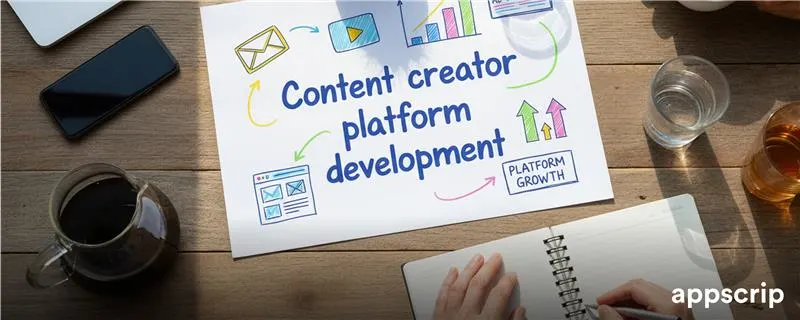
The creator economy isn’t a trend anymore — it’s a structural shift in how digital commerce works. And right now, the smartest money is going into content creator platform development. Not into content itself, but into the infrastructure that powers creators to earn directly from their audiences at scale.
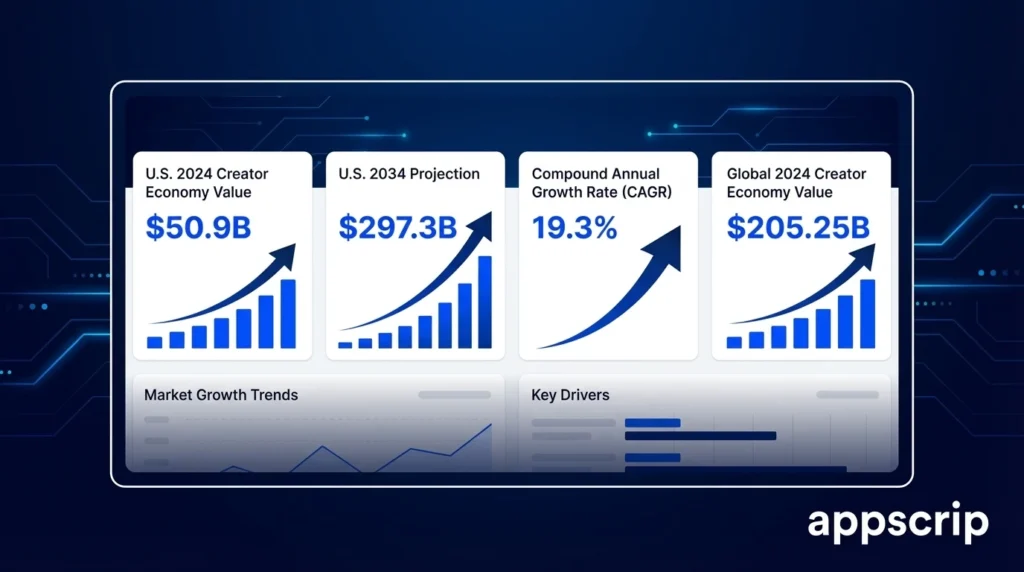
If you’re an entrepreneur evaluating this space, the window is wide open. The U.S. creator economy was valued at $50.9 billion in 2024 and is projected to grow to $297.3 billion by 2034 at a 19.3% CAGR. Globally, the market hit $205.25 billion in 2024 and is on track toward $1.3 trillion by 2033. The demand for platforms — not just content — is what’s driving that number.
This blog will show you what it takes to build a content creator platform that creators want to use, fans are willing to pay for, and investors can get excited about.
Why Content Creator Platform Development Is a Billion-Dollar Opportunity Right Now
The timing has never been more favorable for platform builders. The U.S. alone has over 45 million professional content creators — and most of them are actively looking for better monetization infrastructure. Third-party platforms take too large a cut, impose unpredictable algorithm changes, and offer creators zero ownership over their audiences.
That frustration is the market opportunity. Creators are migrating toward platforms that give them direct-to-fan control — and they’re willing to pay platform fees to operators who deliver that experience reliably.
Several forces are converging right now to make this the right moment to build:
- Subscription fatigue on mainstream platforms is pushing creators toward niche, owned communities
- AI tooling has dramatically reduced platform development costs and timelines
- Payment infrastructure (Stripe Connect, MassPay, Wingspan) has made multi-currency, instant-payout platforms buildable by smaller teams
- 51.5% of creators reported earnings growth year-over-year in 2025, signaling a monetization-ready audience
The creator economy market size data makes one thing clear: the platforms capturing the most value aren’t the social networks. They’re the direct-to-fan monetization layers sitting on top.
| Market | 2024 Value | 2034 Projection | CAGR |
| U.S. Creator Economy | $50.9B | $297.3B | 19.30% |
| Global Creator Economy | $205.25B | $1,345.54B | 23.30% |
| North America Share | 37.4% of global | — | — |
What Makes a Content Creator Platform Actually Work
The platforms that fail aren’t lacking content — they’re lacking the right feature architecture. Content creator platform development succeeds or fails based on how well it solves two problems simultaneously: helping creators earn more and giving fans a reason to keep paying.
Your platform’s architecture needs to support that from day one, not as a retrofit—while also considering operational elements such as scalability, compliance, and global device security for creators and users accessing the platform from different regions and devices.
Before writing a single line of code, you need to map out the core feature stack. Here’s what the market has validated as non-negotiable:
Creator-side must-haves:
- Subscription tiers with recurring billing
- Pay-per-view (PPV) content locking
- Direct messaging with optional charge gates
- Live streaming with integrated tipping
- Content vault for scheduled or exclusive releases
- Analytics dashboard (earnings, subscriber behavior, top fans)
Fan-side must-haves:
- Seamless onboarding and identity verification
- Wallet/coin system for micro-transactions
- Video call access to creators (approved sessions)
- Personalized content request system
Platform-side infrastructure:
- Agency management tools (multi-agent, commission-split models)
- Chargeback protection and fraud detection
- CRM and bulk messaging for creator outreach
- AI-assisted messaging and response tools
| Feature Category | Why It Matters | Revenue Impact |
| Subscription tiers | Predictable, recurring creator income | High — baseline revenue model |
| PPV content | Upsell beyond subscriptions | High — top earners use this daily |
| DM charge gates | Deepens fan relationships + earns | Medium-High |
| Live streaming + tips | Real-time engagement + impulse spend | High — especially in US market |
| Agency tools | Scales platform without creator burnout | Platform-level differentiator |
Choosing the Right Monetization Model for Your Creator Platform
This is where most first-time platform builders make expensive mistakes. They launch with a single revenue model and discover it doesn’t match how their creator base actually earns. The creator economy business models data is clear: top-performing creators run 3–4 revenue streams simultaneously.
Your platform’s architecture needs to support that from day one, not as a retrofit.
The four proven models — and how to stack them:
1. Subscription-based: Fans pay a monthly fee for access to a creator’s content. This is your income baseline. It’s predictable but requires creators to consistently produce.
2. Pay-per-view: Individual pieces of premium content are locked behind a one-time fee. Works best for high-production videos, exclusive events, and personal content.
3. Tipping and virtual gifting: Fans send micro-payments during live streams or in response to posts. OnlyFans users, for example, can send coin-based tips directly. This rewards creators in real time and drives impulse spend.
4. Custom content requests: Fans pay creators to produce personalized content. High margin, highly engaging, and a strong loyalty driver.
The strongest platforms combine all four into a hybrid model — giving creators flexibility while giving the platform multiple revenue-share touch points.
| Model | Best For | Platform Revenue Mechanism |
| Subscriptions | Consistent earners with loyal audiences | Monthly % commission on fees |
| PPV | Premium content creators | Per-transaction % cut |
| Tips/Gifts | Live streamers, engagement-driven creators | % of coin conversion |
| Custom requests | Personal brand creators | % of request fee |
| Hybrid (all four) | Scaling creator platforms | Maximum per-creator monetization |
The Build vs. Buy Decision: Custom Development vs. White-Label
This is the highest-stakes decision in your entire platform journey — and it’s worth treating it as a financial model question, not just a technology question.
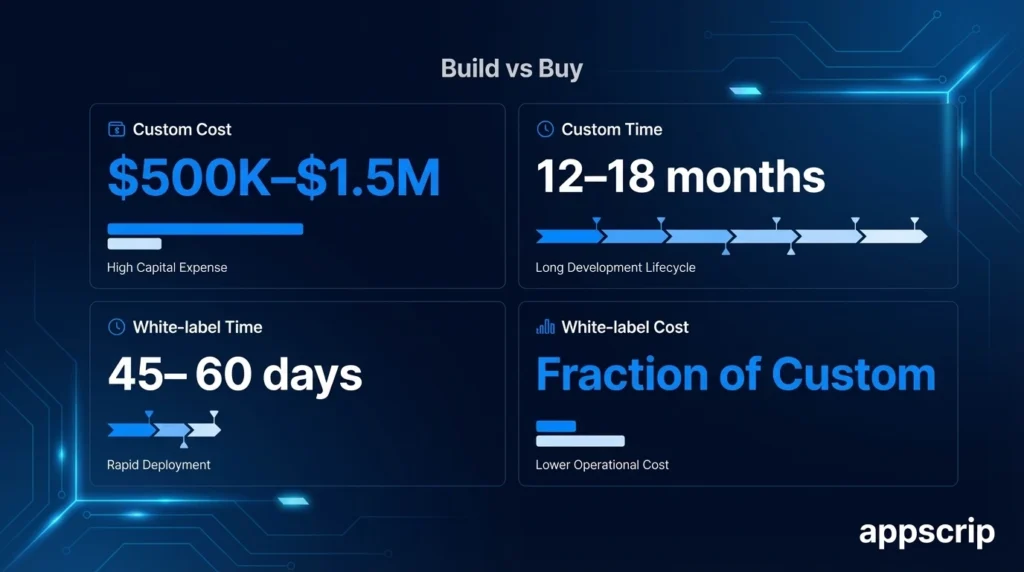
Custom development for a feature-complete creator platform typically runs $500K–$1.5M and takes 12–18 months before you have anything launchable. That timeline assumes an experienced engineering team, a well-defined spec, and no major pivots. In a market moving this fast, that’s a long time to wait before testing whether your monetization model actually works.
White-label platform development compresses that to 60 days or less, with pre-built infrastructure for payments, creator tools, admin panels, and mobile apps already tested in production.

The trade-off is real: white-label solutions require customization work to differentiate your platform. But the customization problem is far cheaper and faster to solve than the core infrastructure problem.
Here’s how the two paths compare honestly:
| Factor | Custom Development | White-Label Solution |
| Time to launch | 12–18 months | 45–60 days |
| Upfront cost | $500K–$1.5M+ | Fraction of custom cost |
| Payment infra | Must build from scratch | Pre-integrated (Stripe, MassPay) |
| Creator tools | Must spec and build | Ready to deploy |
| Risk | High (unproven architecture) | Low (battle-tested code) |
| Customization | Full | Significant, within framework |
For entrepreneurs entering the creator economy now, white-label development lets you validate your market, iterate on features, and capture early creator supply — before competitors even finish their MVP. That’s the real competitive advantage.
Key Features That Separate Winning Platforms from Abandoned Ones
Platform retention is the game. A creator who earns well on your platform stays. A fan who consistently gets exclusive access renews. Everything else is secondary. Understanding content monetization strategies that drive retention is just as important as the initial build.
The features below aren’t nice-to-haves — they’re the difference between platforms that scale and platforms that stall:
AI-assisted messaging: Creators can’t personally respond to thousands of fans. AI that understands a creator’s communication style and generates personalized response suggestions keeps fans engaged without burning out creators.
Agency management infrastructure: The most successful creator platforms support agencies — teams that manage creators’ content, messaging, and subscriber lists on their behalf. Without this, your top earners will cap out and leave for platforms that do support it.
Advanced analytics: Creators need to know their top fans by spend, which content drives the most PPV purchases, and where subscriber churn is happening. A basic view counter isn’t enough.
Chargeback protection: Subscription businesses are vulnerable to payment disputes. Built-in chargeback detection protects both creators and platform operators from fraud-driven revenue loss.
Content vault with scheduling: Agencies and solo creators need to batch-produce content and release it on a schedule. This dramatically improves creator consistency and platform content density.
Instant payouts: This is a direct competitive advantage. Platforms like Fanvue have captured significant creator share specifically because they offer faster withdrawals than incumbents. US creators expect this.
How to Launch Your Content Creator Platform in Under 60 Days
The path from idea to live platform is more direct than most entrepreneurs realize — if you start with the right foundation. Here’s how a structured launch actually looks:
Week 1–2: Platform definition and scoping
Define your creator niche (fitness, adult content, education, entertainment), your monetization mix, and your geographic target. US-first platforms should prioritize USD-denominated payouts, US-compliant payment processors, and DMCA content protection from day one.
Week 2–3: White-label platform selection and customization
Choose your base platform — whether that’s an OnlyFans clone, a Fanvue clone, or a Fansly clone — based on which feature set best matches your target creator type. Customization includes branding, subscription tier structure, and commission rates.
Week 3–4: Payment and compliance integration
Connect your payment stack. For US platforms, Stripe Connect is standard. MassPay or Wingspan integration enables instant creator payouts. Set up 1099 reporting infrastructure — it’s a legal requirement for US platforms paying creators above IRS thresholds.
Week 4–5: Creator onboarding and verification
Build your creator application flow. ID verification (KYC) is essential — both for legal compliance and for protecting fan trust. Pre-recruit 20–50 creators before public launch to ensure your platform has content from day one.
Week 5–6: Beta launch and iteration
Launch to a closed group. Measure creator earnings, fan retention, and content upload frequency. Fix friction points before scaling. Most white-label platforms built on proven infrastructure make this phase dramatically faster than custom builds.
The build process for an app like OnlyFans requires careful planning at each stage — but with the right development partner, none of these steps require you to start from scratch.
Ready to Build Your Content Creator Platform?
Content creator platform development is one of the most defensible business models available to entrepreneurs right now. The market is growing at 23%+ annually. Creators in the U.S. are actively seeking better infrastructure. And the technology to build production-ready platforms in under 60 days now exists.
The question isn’t whether to build — it’s how fast you can get to market and how well your platform serves creators from day one.
Appscrip’s white-label solutions — including our OnlyFans clone, Fanvue clone, and Fansly clone — are built for exactly this. Pre-integrated payments, creator-first feature sets, agency management tools, AI messaging, and instant payout infrastructure — all ready to customize and launch.
On the content side, creators are also leaning on AI workflow design tools like Picsart Flow to go from raw footage to polished, on-brand posts faster — which matters directly to retention, since platforms succeed or fail based on how consistently their creators can keep producing.
If you’re serious about owning a piece of this market, now is the time to move.