A shopper in Chicago ordered a phone charger on a delivery app and had it at their door in 18 minutes. No browsing. No two-day wait. Just instant. That moment — multiplied across millions of urban consumers — is exactly why the quick commerce vs ecommerce debate has become the defining question for retail entrepreneurs.
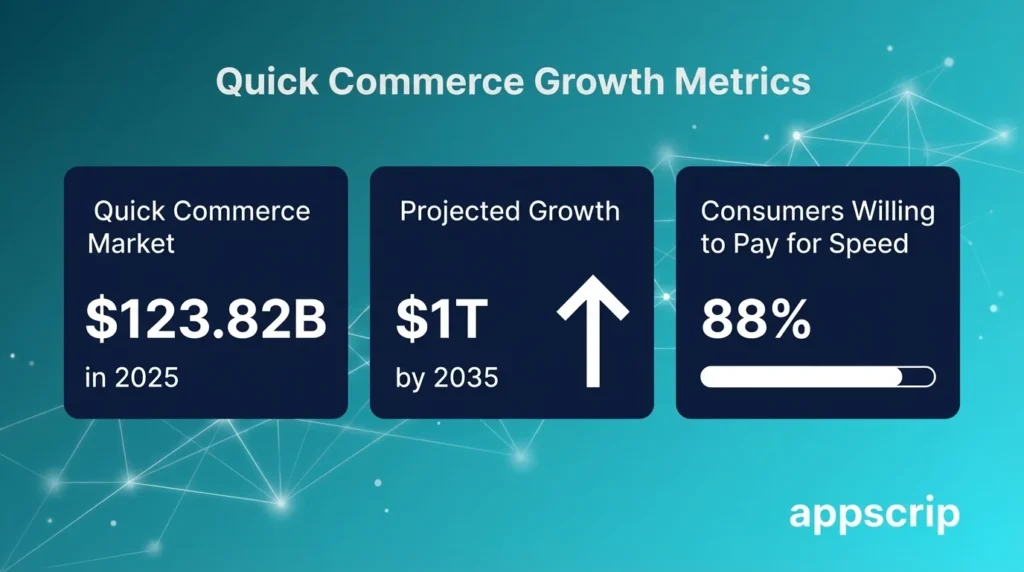
Both models sell products online. But they operate on different principles, serve different customer mindsets, and demand different infrastructure. The global quick commerce market is projected to grow from $123.82 billion in 2025 to over $1 trillion by 2035. Meanwhile, traditional ecommerce continues to dominate at scale — global online retail crossed $4.12 trillion in 2024. These are two different opportunity sets.
Whether you’re launching a new retail platform or scaling an existing ecommerce business, understanding this divide will determine where your investment delivers the highest return. Let’s break it down.
What Is Quick Commerce vs Ecommerce — And Why the Difference Matters Now
Ecommerce (Traditional Model)
Ecommerce, in its traditional form, is built around selection, price, and accessibility.
How it works:
- Businesses list products online
- Customers browse and place orders
- Deliveries happen within 1 to 7 days
Key characteristics:
- Massive product catalogs (millions of SKUs)
- Centralized warehouses
- Logistics optimized for scale and volume
Examples:
- Amazon, Walmart, eBay, Shopify-powered stores
Quick Commerce (Q-Commerce)
Quick commerce flips the model. Here, speed is the product.
How it works:
- Orders are fulfilled within 10 to 30 minutes
- Inventory is stored in micro-fulfillment centers (aka dark stores)
- Locations are placed close to urban consumers
Key characteristics:
- Limited but high-demand inventory
- Hyperlocal delivery radius
- Logistics optimized for speed over scale
Examples:
- GoPuff, Instacart, DoorDash DashMart, Uber Eats
Why This Difference Matters Now
Consumer expectations have fundamentally shifted.
What’s driving the change:
- 88% of consumers are willing to pay more for faster delivery (PwC)
- The on-demand mindset—shaped by food delivery apps—has expanded into:
- Groceries
- Pharmaceuticals
- Electronics accessories
- Even apparel
The Strategic Shift for Entrepreneurs
The core question is no longer: “Should I sell online?”
It is now: “How fast does my customer need it?”
How Each Model Works: Dark Stores, Warehouses, and the Last Mile
Understanding the operational backbone of each model is essential before you choose one — or combine both.
Traditional ecommerce operates through large, centralized fulfillment centers. When a customer places an order, it flows through an OMS (order management system), inventory is checked across warehouses, payment is processed, and the order is picked, packed, and shipped via a logistics partner. Delivery takes one to seven days, though same-day options are expanding in dense metro areas.
Quick commerce works through a decentralized, hyperlocal model:
- A customer orders through the app
- The order is routed to the nearest dark store — typically within a 1–3 mile radius
- A picker fulfills the order from a curated inventory of 1,000–5,000 SKUs
- A delivery rider completes last-mile fulfillment, usually in under 30 minutes
- The entire flow is powered by real-time inventory management and AI-driven route optimization
Streamlining these multi-layered backend workflows often requires specialized Shopify development services to enable real-time inventory synchronization between online storefronts and distributed fulfillment networks.
The dark store is the critical infrastructure difference. Unlike a traditional warehouse, a dark store is a small retail-format facility closed to the public, optimized entirely for picking speed. In the US, approximately 200 dark stores currently support quick commerce operations — a number growing rapidly as Amazon, Walmart, and pure-play platforms expand.
The quick commerce business model also introduces operational costs that don’t exist in traditional ecommerce: storage fees per dark store, inward processing fees, per-listing charges on marketplace platforms, and the complexity of maintaining real-time stock accuracy across multiple micro-locations simultaneously.
Quick Commerce vs Ecommerce: A Head-to-Head Breakdown
Here’s how the two models stack up across the metrics that matter most to operators and investors.
| Aspect | Ecommerce (Traditional) | Quick Commerce (Q-Commerce) |
| Core Value Proposition | Selection, price, convenience | Speed and immediacy |
| Delivery Time | 1 to 7 days | 10 to 30 minutes |
| Inventory Model | Large catalogs (millions of SKUs) | Limited, high-demand products |
| Fulfillment Centers | Centralized warehouses | Micro-fulfillment centers (dark stores) |
| Location Strategy | Often far from customers | Located within a few miles of users |
| Logistics Focus | Scale and cost efficiency | Speed and last-mile optimization |
| Customer Mindset | Planned purchases | Impulse and urgent needs |
| Product Categories | Everything (long-tail inventory) | Essentials (groceries, meds, daily-use items) |
| Unit Economics | Margin-driven, optimized over time | High cost per order, needs density to work |
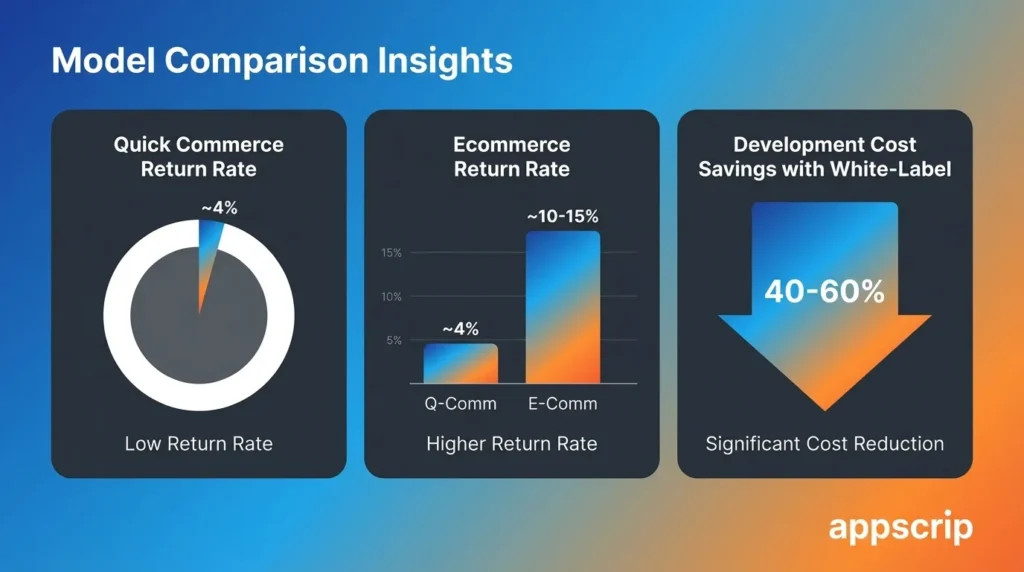
| Avg. Return Rate | ~10–15% | ~4% |
| Operational Cost | Lower at scale | High per-order (last-mile, dark store) |
| Tech Requirements | Search, personalization, logistics management | Route optimization, real-time inventory, live tracking |
| Examples | Amazon, Walmart, eBay, Shopify stores | GoPuff, Instacart, DoorDash DashMart, Uber Eats |
The return rate differential is worth pausing on. Quick commerce sees significantly fewer returns because customers order out of genuine, immediate need — not browsing-driven impulse that leads to regret. That translates directly to lower reverse logistics costs and cleaner unit economics over time.
Where Quick Commerce Is Winning — and Where Ecommerce Holds Its Ground
Neither model is universally superior. Each dominates in specific contexts, and smart businesses are increasingly looking at a hybrid approach.
Quick commerce is winning in:
- Groceries and daily essentials (the largest segment, at ~43% of q-commerce share)
- Pharmaceuticals and OTC medicines
- Convenience categories: snacks, beverages, personal care
- Urban markets with high population density and smartphone penetration
- Impulse and emergency purchase moments
In the US, platforms like DoorDash and Instacart are aggressively expanding quick commerce capabilities. DoorDash launched drone delivery in Charlotte in May 2025. Amazon committed $4 billion in June 2025 to extend faster Prime delivery to 4,000 smaller communities. The infrastructure investment signals long-term commitment, not experimentation.
Traditional ecommerce holds firm in:
- High-consideration purchases: electronics, furniture, appliances
- Fashion and apparel with high SKU variety
- Tier-2 and Tier-3 cities and rural markets
- B2B and wholesale buying
- Products requiring detailed research, comparisons, and reviews
| Business Scenario | Recommended Model | Reason |
| Grocery / pharmacy startup | Quick Commerce | Urgency-driven demand, repeat order frequency |
| Multi-category retail brand | Ecommerce | Catalog depth, scalable logistics |
| Urban convenience store digitization | Quick Commerce | Hyperlocal coverage, dark store conversion |
| D2C fashion or electronics brand | Ecommerce | Discovery-driven buying, higher AOV |
| FMCG brand expanding digital reach | Hybrid | Speed for daily SKUs, ecommerce for full catalog |
The quick commerce opportunity in the US is particularly strong for operators who can identify high-density urban corridors where the dark store density justifies the investment. In markets outside the US, Europe’s Getir and Flink, and India’s Blinkit and Zepto, have demonstrated that the model scales where urban population density is high and smartphone penetration is strong.
Which Model Should You Build For? A Decision Framework for Entrepreneurs
If you’re evaluating your entry point — or considering an expansion from ecommerce into quick commerce — here’s a practical framework to guide the decision.
Start with your product category. Products that are consumed frequently, have low deliberation time, and create genuine urgency (groceries, medicines, snacks, baby care) are natural fits for quick commerce. Products that require comparison, customization, or longer consideration cycles belong in ecommerce.
Evaluate your geography. Quick commerce requires a minimum order density to justify dark store operations. Without it, per-order delivery costs become unsustainable. Major US metro areas — New York, LA, Chicago, Houston — have demonstrated viability. Suburban and rural markets still lean ecommerce.

Know your budget reality. Entering quick commerce as a platform builder requires meaningful upfront capital:
- Dark store setup and lease costs
- Inventory stocking at each micro-location
- Real-time tech infrastructure: inventory management, route optimization, live tracking
- Delivery fleet or third-party logistics partnerships
Ecommerce entry, by contrast, can begin lean — a Shopify store or marketplace listing with minimal infrastructure. Quick commerce demands heavier upfront commitment but can yield higher order frequency and lower return rates at maturity.
Consider the hybrid path. Amazon, Walmart, and Flipkart have all moved in this direction — maintaining broad ecommerce catalogs while building express delivery infrastructure for high-velocity SKUs. For most entrepreneurs, this isn’t a “either-or” decision. It’s a “sequence” decision. Start where your audience is, prove unit economics, then expand.
| Entrepreneur Profile | Recommended Starting Point |
| First-time founder, limited capital | Ecommerce (lower barrier to entry) |
| Existing ecommerce seller, urban market | Explore quick commerce for top SKUs |
| Investor-backed startup, metro focus | Quick commerce — dark store model |
| Brick-and-mortar retailer going digital | Hyperlocal / quick commerce hybrid |
| Brand with high-repeat, low-consideration SKUs | Quick commerce alongside ecommerce |
Launching in the Speed Economy: What Your Tech Stack Needs to Deliver
Choosing the right model is only half the decision. The other half is infrastructure — and this is where most builds succeed or stall.
For quick commerce specifically, your technology has to do more than process orders. It needs to manage real-time inventory across multiple dark stores, optimize delivery routes dynamically, notify pickers the moment an order arrives, and give customers live tracking from store to door.
Key technical components for a quick commerce platform include:
- Customer app with fast checkout, real-time order tracking, and intelligent product recommendations
- Picker app with order staging workflows — from “not picked” to “in review” to “dispatched”
- Driver app with optimized routing and order handoff management
- Store admin panel for dark store-level inventory, earnings tracking, and order analytics
- Super admin dashboard for multi-store oversight, pricing control, and business intelligence
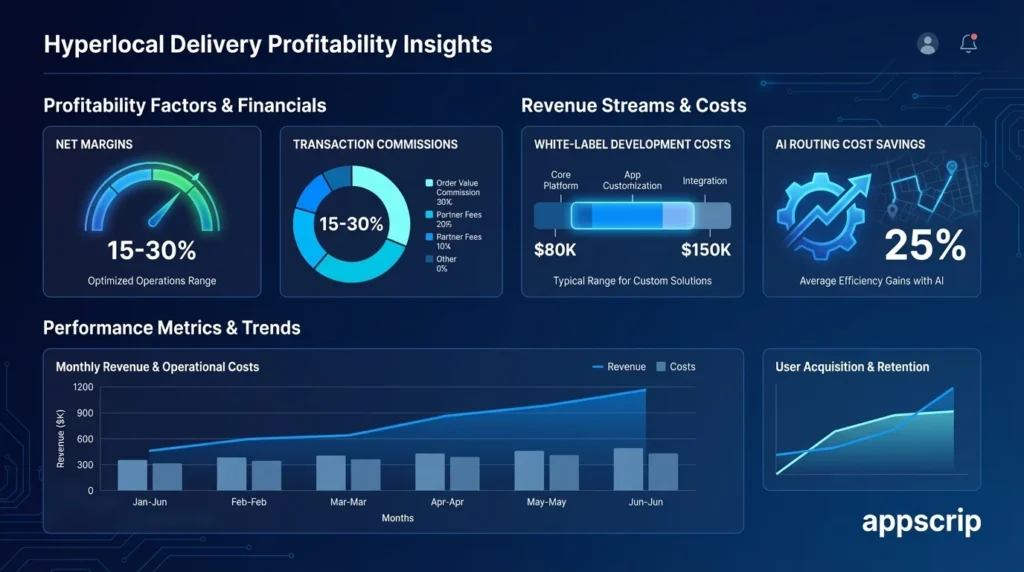
Building this from scratch is expensive and time-consuming — typically $150,000–$400,000+ for a fully featured platform, with timelines of 9–18 months. That’s before a single order ships.
How & Why: Quick Commerce vs Ecommerce
The faster path is a white-label solution built specifically for the q-commerce model. Appscrip’s quick commerce software — purpose-built for dark store operations — covers all five layers above in a single deployable stack.
The platform supports multi-store management, AI-driven inventory alerts, live delivery tracking, and a super admin console with full order and revenue analytics. It’s built on microservice architecture, which means it scales without re-architecting as your order volume grows.
For entrepreneurs who need to validate market demand fast before committing to a full custom build, a white-label approach like this cuts development costs by 40–60% and compresses launch timelines to weeks rather than months.
Equally, for established ecommerce businesses testing a quick commerce vertical, it offers a low-risk way to add the capability without rebuilding existing infrastructure.
To understand the full cost picture before you commit, see what it costs to build a quick commerce app and what features drive the most value at each stage.
The Bottom Line: Speed Is a Business Model, Not Just a Feature
Quick commerce vs ecommerce isn’t a winner-take-all contest. The global market is large enough — and consumer behavior diverse enough — for both to thrive simultaneously. Customers no longer accept three-day shipping for things they need today. That shift creates a real opportunity for entrepreneurs who move into the quick commerce space.
If you’re building for the speed economy — whether launching a new platform or extending an existing retail operation — the technology you deploy will determine how fast you can move.
Appscrip’s quick commerce software gives you the infrastructure to launch quickly, operate efficiently, and scale without limits. Ready to build? Get in touch with the Appscrip team and see how fast your launch can actually be.